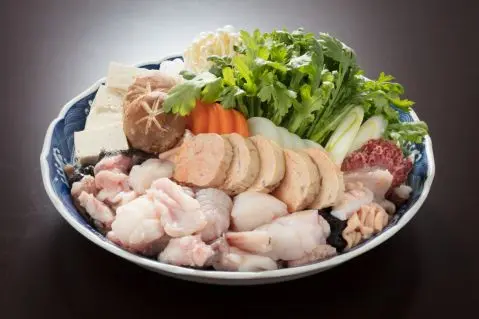
Dobujiru (Waterless monkfish hot pot)
A rich, wintertime monkfish hot pot from Fukushima’s Hamadori region

About Dobujiru (Waterless monkfish hot pot)
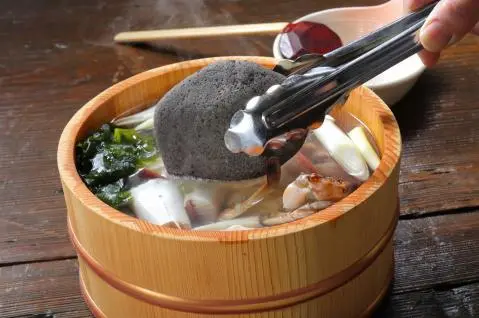
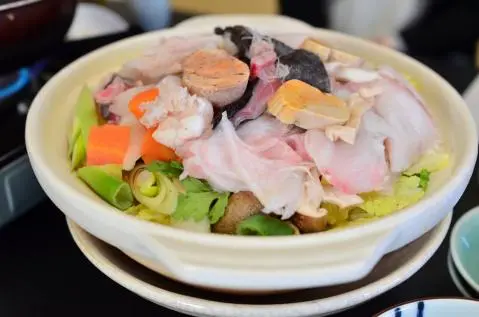
Dobujiru, a winter specialty rooted in Fukushima Prefecture’s Hamadori region, is a local dish with a robust yet delicate flavor, said to have originated in the area’s fishing ports. It is traditionally said that fishermen would break down monkfish aboard their boats and cook it in a hot pot on the spot. Its defining feature is that no water is added: monkfish liver is first sautéed to release its natural fat and savory flavor, then the monkfish’s meat, skin, stomach and other parts are simmered with vegetables such as napa cabbage and long onion. Miso is added to season the broth.
There are several theories about the name “dobujiru.” One suggests it refers to the way the broth turns cloudy as the monkfish liver dissolves, resembling “dobu,” or muddy water. Another theory links the name to the idea of using every part of the monkfish. Either way, the dish reflects a resourceful approach to making full use of what is available.
Monkfish liver is rich in vitamins A and D and unsaturated fatty acids such as EPA and DHA. The source describes these nutrients as beneficial for immune function and circulation. Dobujiru pairs well with junmai sake from Fukushima Prefecture; its clean finish complements the hot pot’s richness.
Today, many restaurants, particularly in Iwaki City, Fukushima Prefecture, serve dobujiru during the winter season, warming visitors with its hearty flavor. Bringing together food tradition and local culture, it is a dish worth experiencing at least once.
Related videos
Reviews
There are no reviews yet.
Regional cuisine of Fukushima region



Japanese Cuisine - Nabe dish



Kind of food
Recommended
-
![Manganji Peppers (Manganji Sweet Peppers)]()
Manganji Peppers (Manganji Sweet Peppers)
Kyoto / >Local cuisine -
![Natural Rock Oysters]()
Natural Rock Oysters
Akita / >Seafood -
![Hita Yakisoba]()
Hita Yakisoba
Oita / >Soba & Udon -
![Grilled Mackerel of Unnan]()
Grilled Mackerel of Unnan
Shimane / >Seafood -
![Sendai Zoni]()
Sendai Zoni
Miyagi / >Seafood -
![Takoyaki]()
Takoyaki
Osaka / >Okonomiyaki & Takoyaki -
![Taiping Yan]()
Taiping Yan
Kumamoto / >Ramen -
![Ramen Salad]()
Ramen Salad
Hokkaido / >Local cuisine